
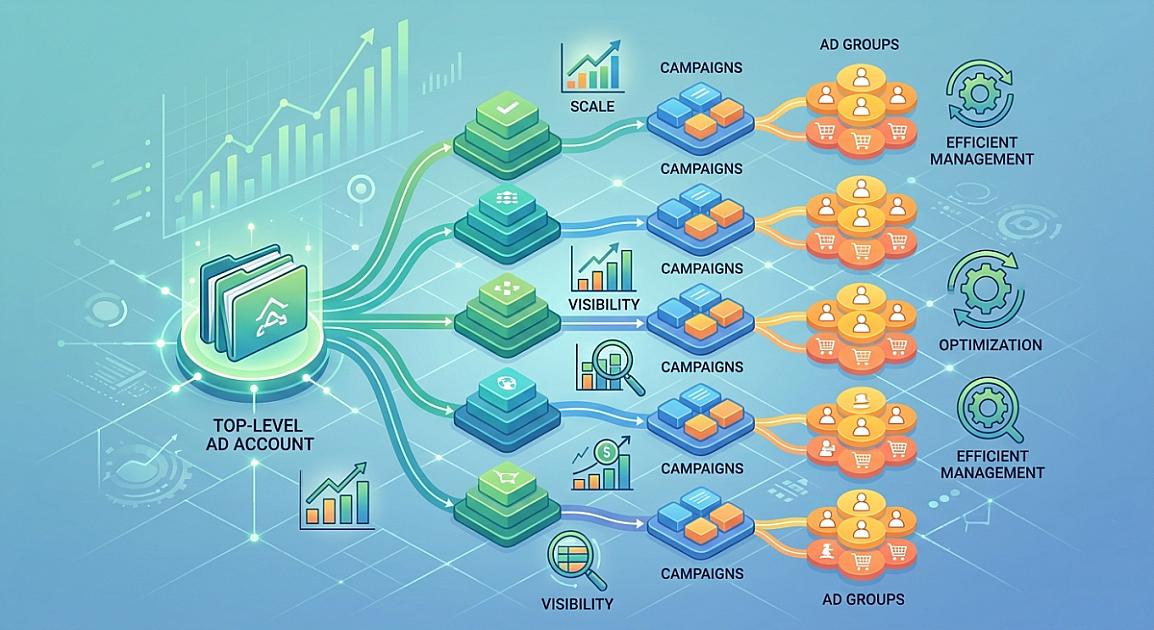
Account structure is the skeleton of your advertising program. A well-organized account makes optimization efficient, testing clear, and scaling straightforward. A poorly structured account creates confusion, internal competition between campaigns, and optimization decisions based on misleading data. Investing time in proper account structure from the beginning pays dividends for as long as you run advertising.
The Hierarchy: Campaign, Ad Set, Ad
All major advertising platforms share a three-level hierarchy, though the names vary slightly:
Campaign level: Sets the overall objective (conversions, traffic, awareness), budget type (daily or lifetime), and in some platforms, the campaign-level bid strategy. Controls the highest-level parameters.
Ad Set (Meta) / Ad Group (Google): Controls targeting (audience, keywords, placement), bid strategy, schedule, and budget at the segment level. Multiple ad sets allow you to test different targeting approaches within the same campaign objective.
Ad (Creative): The actual advertisement users see. Multiple ads within an ad set allow for creative testing. Performance data at this level informs creative strategy.
Organizing Campaigns by Funnel Stage
The most important structural principle: separate campaigns by their role in the customer journey.
Prospecting campaigns: Target new audiences who don't know your brand. Set optimized for initial action (video views, content engagement, or top-funnel conversions).
Consideration / Middle-funnel campaigns: Target engaged audiences — video viewers, page visitors, email subscribers. Use different creative and offers appropriate for the consideration stage.
Retargeting campaigns: Target people who have visited your site, added to cart, or otherwise demonstrated high intent. Requires strict exclusions to prevent audience overlap with prospecting.
This separation enables appropriate budget allocation, prevents audiences from seeing wrong-funnel messages, and allows accurate ROAS measurement by funnel stage.
Naming Conventions: The Foundation of Account Management
Consistent naming conventions are essential once you have more than a handful of campaigns. Without them, account management at scale becomes chaotic.
A good naming convention for campaigns includes: the funnel stage, the audience or targeting type, the offer or product, and the date started. Example: PROS_LAL_1PCT_TRIAL_2024Q3
For ad sets: the specific targeting detail and testing variant. Example: LAL_1PCT_F25-45_US
For ads: the creative type, format, and variant identifier. Example: VID_UGC_HOOK_01
Document your naming convention and enforce it across the entire team. Inconsistency makes the convention worthless.
Avoiding Internal Campaign Cannibalism
One of the most common account structure mistakes is running campaigns that compete against each other for the same audience inventory:
Audience overlap: When two prospecting campaigns target overlapping audiences, they bid against each other in the same auctions — driving up your own CPMs.
Keyword overlap: In Google Ads, campaigns targeting overlapping keyword sets compete in the same auctions. Use Google's Auction Insights report to detect this.
Solutions: Use Google's Campaign Exclusions, Meta's Audience Overlap tool, and careful audience exclusion logic at the ad set level to ensure campaigns serve complementary rather than competing audiences.
When to Consolidate vs. Segment Campaigns
Account structure decisions involve a tension between segmentation (for control and visibility) and consolidation (for algorithmic optimization):
Consolidation benefits: Modern platform algorithms (especially Meta's Advantage+ and Google's Smart Bidding) perform better with more data in a single campaign. Consolidating too many small campaigns into fewer larger ones often improves overall performance.
Segmentation benefits: Separate campaigns for different products, geographies, or funnel stages give you precise budget control, clear performance attribution, and the ability to optimize each segment independently.
The right balance depends on your account scale. Smaller budgets typically benefit from more consolidation. Larger budgets can support more granular segmentation without sacrificing algorithmic performance.