
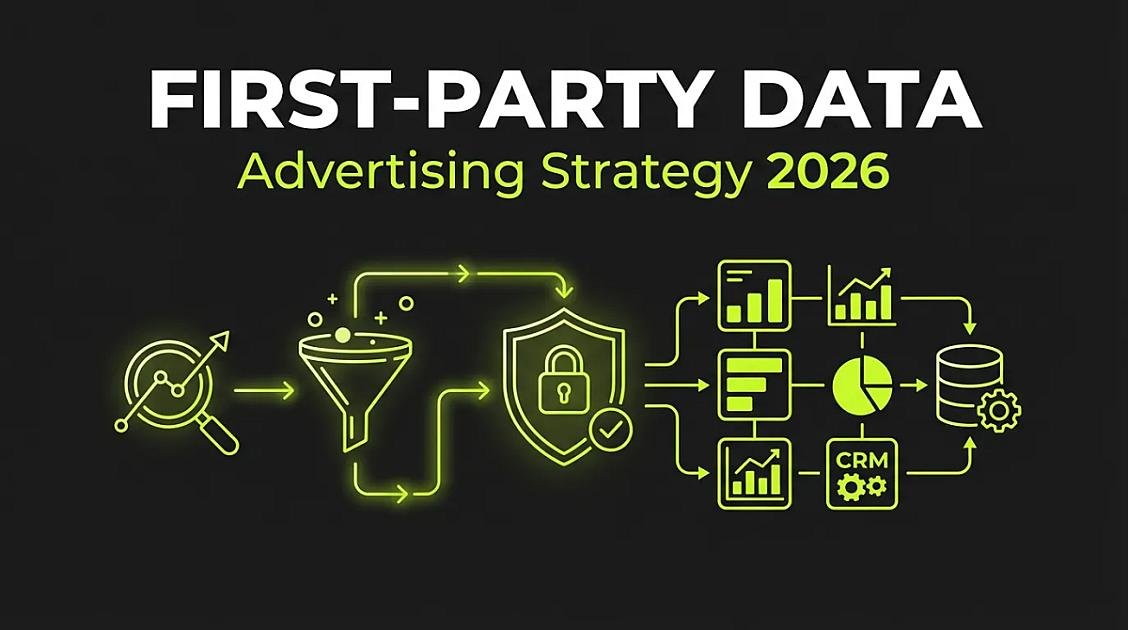
First-party data — information collected directly from your customers and prospects through your own owned channels — is rapidly becoming the most valuable asset in digital marketing. As third-party cookies disappear, privacy regulations tighten, and platforms restrict audience sharing, the brands with the richest first-party data will have a durable competitive advantage that no algorithm change or policy update can take away.
What Is First-Party Data?
First-party data is any information that users willingly share with your business through direct interaction:
Email and contact information from newsletter signups, account registrations, and purchase completions.
Behavioral data from your website: pages visited, products viewed, content consumed, time spent, and actions taken.
Purchase history: what was bought, when, how much was spent, and how frequently.
Preference data: survey responses, product preference settings, communication preferences.
App data: usage patterns, in-app behavior, and feature adoption.
Customer service interactions: support history, feedback, and complaints.
This data is owned by you — not licensed from a platform or purchased from a third party. It cannot be taken away by platform policy changes.
Building First-Party Data Collection Infrastructure
Email capture: Every owned channel should be capturing email addresses. On-site pop-ups, exit-intent forms, content upgrades, free tools, and loyalty programs are all effective collection mechanisms.
Identity resolution: A Customer Data Platform (CDP) or marketing automation platform that connects different data sources (email, CRM, website behavior, purchase data) into unified customer profiles.
Progressive profiling: Rather than asking for all customer information upfront (which reduces conversion), collect additional attributes over time as customers interact with your brand.
Events and APIs: Server-side tracking that captures behavioral data accurately regardless of browser-level restrictions. Essential for maintaining data quality as client-side tracking becomes less reliable.
Using First-Party Data in Advertising
Customer match audiences: Upload your email lists to Google, Meta, LinkedIn, and TikTok to target your customers directly on each platform — or exclude them from acquisition campaigns.
Seed audiences for lookalikes: Your best customer segments — highest LTV, most frequent purchasers, most engaged subscribers — make the highest-quality seed audiences for lookalike targeting.
Personalized retargeting: Use behavioral data to show contextually relevant ads. Users who viewed a specific product category should see ads featuring products from that category, not generic brand ads.
Cross-sell and upsell campaigns: Purchase history enables precise targeting for cross-sell campaigns. A customer who bought product A and has a high propensity to need product B is a high-value retargeting opportunity.
Email as Your Primary First-Party Data Channel
Your email list is the most valuable first-party data asset most businesses own. Unlike social media followers or platform audiences, your email list is truly owned — no algorithm change can reduce your reach to zero.
Grow your list intentionally: Every piece of content you create, every product you sell, every customer service interaction is an opportunity to capture email addresses.
Maintain list quality: A large, engaged list is more valuable than a large, unengaged one. Regular list hygiene, segmentation, and re-engagement campaigns maintain the health and value of your list.
Use email performance as a signal: Email engagement data — which subscribers open, click, and convert — is your richest first-party behavioral signal. Use it to identify your best customers and inform advertising strategy.
Privacy Compliance: The Non-Negotiable Foundation
First-party data collection must be conducted with explicit user consent and in compliance with applicable privacy regulations. The primary regulatory frameworks include:
GDPR (EU): Requires explicit consent for data collection and processing, with clear opt-in mechanisms and the right to data deletion.
CCPA/CPRA (California): Requires disclosure of data collection and opt-out mechanisms for data selling.
CAN-SPAM and CASL: Email-specific regulations governing commercial email practices in the US and Canada.
Privacy compliance is not just a legal requirement — it is increasingly a competitive differentiator. Brands with transparent, trustworthy data practices build stronger customer relationships and face lower regulatory risk.